
How Did a 1974 Chico CPA's Idea Become a 50-Year PEO?
Allevity Employer Solutions / PEO Insider cover story
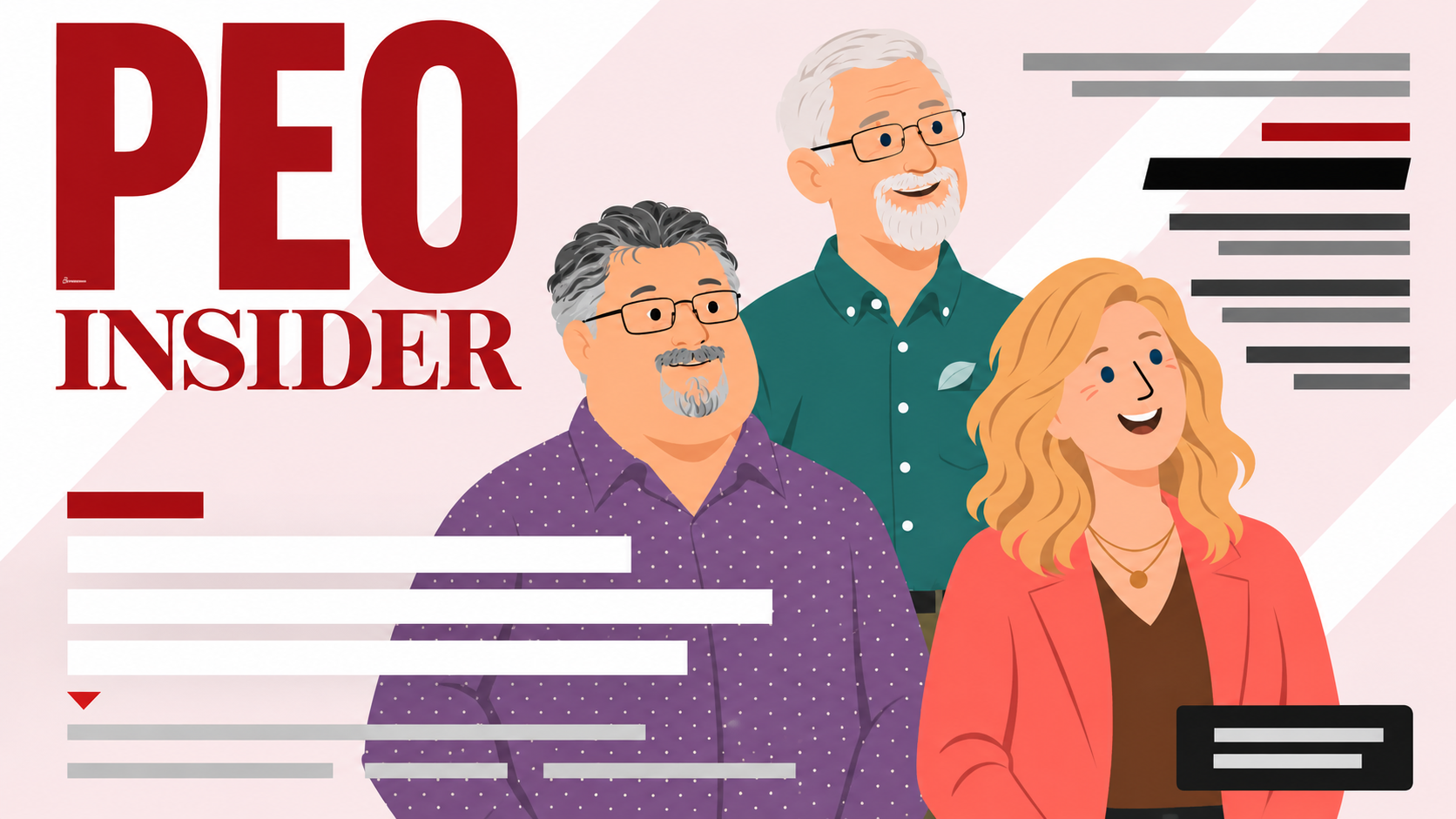
Allevity is the October 2026 cover story of PEO Insider, the publication of the National Association of Professional Employer Organizations (NAPEO). The feature is our origin story: from 1974, when Kent Ahlswede opened Staff Resources, Inc. in Chico, to the team his sons Craig and Kevin Ahlswede lead today. It’s a story that remains relevant, and illustrative of why Kent's founding idea still shapes how we work.
The story, "How Allevity Turned a Founder's Vision Into a 50-Year PEO Legacy," was written by PEO Insider editor Chris Chaney. Craig, Kevin, and Director of Operations Ann Soinila are on the cover. Kent's "aha" in 1974 was simple: business owners needed help managing employees. Fifty years later, that's still the job, and the way Kent chose to do it, with people who know your business, still dictates what happens when you call.
What did Kent Ahlswede see in 1974 that still applies today?
Kent saw that being an employer puts a business at risk in ways the owner sometimes can't see. He was a CPA in Chico when he came across a concerning practice by an early employer-of-record operation. They were paying employees out of their clients' own checking accounts and left the riskiest work, HR, workers' compensation, and health insurance, unmanaged. He researched California labor law, found a framework that let a business lease employees, and opened Staff Resources, Inc. in 1974 as one of the industry's first Professional Employer Organizations—or PEOs.
His CPA background shaped the idea. Owners hire a CPA because they're afraid of the IRS, Kent would tell Craig. Being an employer brings wage-and-hour claims, workers' compensation issues, and employment-practice liabilities that are just as serious and much less understood. "Being an employer is much more risky than people think," Craig says in the story. "They just don't understand the risk that they're putting themselves into."
“Being an employer is much more risky than people think.”
— Craig Ahlswede, in PEO Insider
We once drew the stack of employment law as a graphic, short in 1974 and taller every decade. Today, Craig jokes, "it just goes off the page." Remote work, employees in other states, and new leave rules have joined the wage-and-hour questions that were there from the start, which makes Kent's diagnosis more useful now than it was then.
What was Allevity’s role in building the PEO industry?
Kent Ahlswede was one of 14 operators who founded the National Staff Leasing Association, the group that later became NAPEO. He also served as its first vice president. Our founder helped build the association the PEO industry grew inside.
1974: Staff Resources, Inc. opens in Chico. 1984: Kent helps found the National Staff Leasing Association.
The National Staff Leasing Association believed individual PEOs needed a collective voice if the model was going to survive, and Kent acted on it. Craig remembers traveling to Washington, D.C., with his father in the 1980s, when federal tax reform threatened the industry. "If you want to have a say, or an impact on how laws change, you have to get involved," Kent told him. "You have to be there and be part of the conversation."
We like to say we're a leader in the industry because we helped shape the industry itself. That involvement carried into the next generation. “We helped shape the industry, and the industry continues to shape us in return,” Craig said. Personally, Craig has served as chair of NAPEO's California Leadership Council and stays active in state advocacy, so that laws written for employers account for the PEO relationship.
How did Allevity change without losing the point?
We changed by adapting to what employers needed and by learning to run as an organization instead of one founder's workbench. Craig didn't plan to make the family business his career. He graduated in 1990, worked briefly at the company, and spent several years in recruiting. When Kent had a life-threatening heart condition in 1995, Craig came back to Chico for good, and he became president in 2006.
A founder who can hear nearly every conversation in the building can decide fast and fix things personally. Growth needs something else. "As you grow, you've got to give people the ability, the authority to make decisions, to make mistakes and learn and grow," Craig says.
“As you grow, you've got to give people the ability, the authority to make decisions, to make mistakes and learn and grow.”
— Craig Ahlswede
Kevin joined in September 1998, when we ran a benefits-focused PEO model. He saw employers who didn't want to offer employer-sponsored health insurance getting left out, and he launched Employer Concepts, a blue-collar division that offered PEO services without requiring health coverage. Around 2012 the name changed too. Employees asked whether "Staff Resources," which sounded like a staffing agency, could go, and the team landed on Allevity, a combination of "alleviate" and "levity": taking the burden of being an employer off the owner.
Why does high tech still need high touch?
Craig said it plainly in a recent call: "It takes a human to interpret HR." Software can run a process, but only a person can interpret one. We use technology where it improves service and don't assume every HR function should become an app.
“It takes a human to interpret HR.”
— Craig Ahlswede
"We're not on the bleeding edge of technology. We're on the leading edge," he says. "We're conservative when it comes to laws and regulations." The tools serve the job he names next: "We're going to keep you out of trouble as much as possible."
Making the life of an employer “easy,” as we like to say, means that, when you call us, you're going to get a hold of a knowledgeable person—someone that understands your issue and helps you resolve it in a timely manner, sometimes even drives a long way to come see you in person. In practice, clients get representatives who understand their businesses and histories, and we want clients to see us as an "extension of their own organization."
Who carries the legacy forward now?
The current team. Ask Craig about his hardest leadership challenge and he starts with culture; strategy goes nowhere if employees don't feel valued and don't feel like teammates. Our employees nominate coworkers who go above and beyond for a colleague or a client for a reward like leaving early on a Friday, or an extra day off. The prizes are fun, but it’s the habit of noticing each other’s work that makes the difference. "Giving them the tool to recognize each other has helped so much," Craig says.
His view of leadership has moved the same way. For Craig, it's "about lifting people up, helping others succeed and making sure they receive the recognition for what they achieve."
The story closes on the line that has held since 1974: "Employers have enough to worry about. Allevity exists to make being one easier." We're still your best business decision.
Read the Full Cover Story
The October 2026 issue is open to the public. Read "How Allevity Turned a Founder's Vision Into a 50-Year PEO Legacy" in PEO Insider.
Bringing Us the Employer Question
If you're a Northern California employer with a payroll, HR, recruiting, or staffing question that's outgrown the person who used to handle it, bring it to us. We take the time to learn your business, and we'll tell you where to start. Let's talk.
Frequently asked questions
Where can I read the Allevity cover story?
In PEO Insider, NAPEO's publication, in the October 2026 issue, written by editor Chris Chaney. The current issue is free to read; past issues move behind NAPEO's member login.
Is Allevity the same company as Staff Resources, Inc.?
Yes. Kent Ahlswede founded Staff Resources, Inc. in Chico in 1974. The company became Allevity in 2012, and all divisions came together as Allevity Employer Solutions in 2018.
Did Allevity found NAPEO?
Not alone. In 1984, Kent Ahlswede was one of 14 PEO operators who founded the National Staff Leasing Association, which later became NAPEO, and he served as its first vice president.
What does the name Allevity mean?
It's a combination of "alleviate" and "levity": taking the burden of being an employer off the owner and bringing some ease to a responsibility that can be stressful. Employees proposed the change, and the new name arrived in 2012.
Does Allevity only work with California businesses?
California businesses are Allevity's primary clients, and we support those clients' employees in roughly a dozen other states as they hire remote workers or expand.